
in the pool - tracy mcgrady

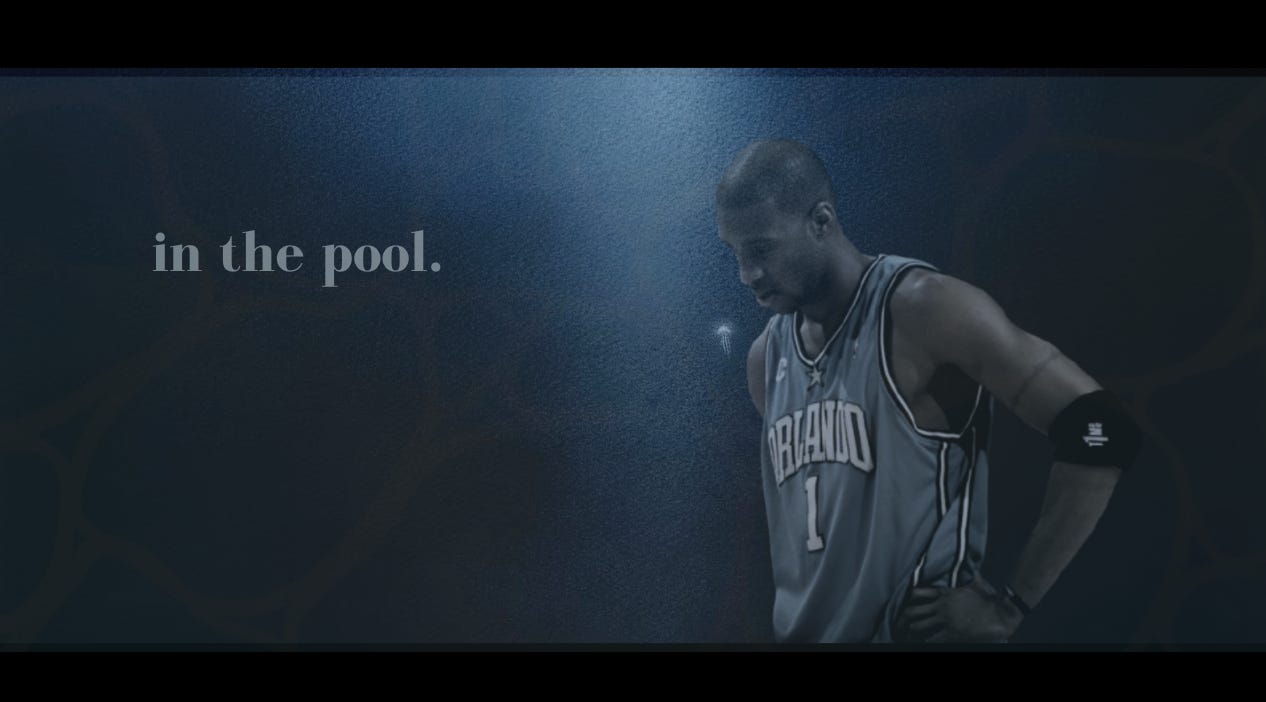
(here’s a suggested background audio so you can see what inspired this piece: in the pool by kensuke ushio)
in the pool, there is only a moment so perfect it feels stolen from somewhere it was never supposed to exist.
you watch it and you already know it ends.
that's tracy mcgrady.
bartow, florida. 1979.
tracy lamar mcgrady jr. was born in a small town in central florida that nobody outside of polk county had ever heard of. the kind of town where the future is whatever you make it with your hands.
he started playing basketball at five.
by the time he was in high school at auburndale, he had already outgrown the town, the gym, and every defender who had ever tried to stop him.
he transferred to mount zion christian academy in durham, north carolina, for his senior year. the kind of school that exists to make diamonds but tmac already was one: 6’8, fluid, with a natural shooting motion that looked like it had been bestowed rather than developed.
the adidas abcd camp that summer was the moment the basketball world collectively stopped breathing.
he was the best player there. by a significant margin.
he was named high school player of the year by usa today.
every major college programme was calling. he could have gone anywhere.
he went straight to the nba.
in the 1997 draft, he was selected ninth overall by the toronto raptors.
but, he almost became a boston celtic.
in the 1997 draft, he was selected ninth overall by the toronto raptors. but he almost became a boston celtic. the celtics had the third and sixth picks. their scouts loved him. they were prepared to take him. and then mcgrady, eighteen years old, sat down for his predraft interview with the celtics' staff and gave them nothing.
deliberately.
because he didn't want to play for rick pitino.
he tanked his own interview so he wouldn't get drafted by boston.
so, the celtics passed. toronto got him ninth.
toronto. the shadow.
his rookie year in toronto was, by his own description, hell.
he averaged only 13 minutes per game under head coach darrell walker, felt lonely in the city, and was sleeping for up to 20 hours a day.
eighteen years old. alone in a country that isn't yours. in an apartment that doesn't feel like home. no role. no identity. no one watching.
just a kid who had been the best player everywhere he had ever been, suddenly invisible.
that silence is the part of the story that NOBODY tells.
he was spending twenty hours a day in bed because there was nothing else to do with a greatness that nobody was using.
nobody was cashing on his promise yet.
and then vince carter arrived.
here is where the story gets genuinely strange.
mcgrady and carter had known each other for years growing up in florida. they played in the same aau circles. they trained together. they knew each other as well as two young basketball players could know each other.
and they had absolutely no idea they were related.
it wasn't until mcgrady was a senior in high school and attended a family reunion that his grandmother introduced him to a cousin who played college basketball at north carolina. the cousin was vince carter.
mcgrady's first phone call to carter was, by all accounts, one of disbelief. he was like, bro, i know you're lying. carter didn't believe it either. they had been moving in the same circles for years, competing against each other, watching each other, and they were blood the whole time.
when the raptors drafted carter in 1998, the two became inseparable. a teammate once said they were less like cousins and more like siamese twins.
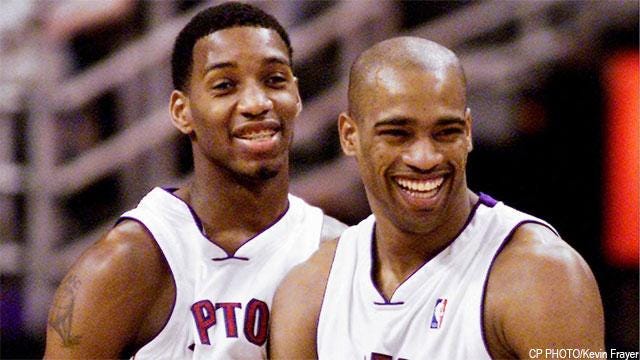
they competed in the 2000 slam dunk contest together which vince won, producing arguably the most spectacular individual dunk contest performance in history, and mcgrady watched from the sideline with genuine joy.
but underneath the brotherhood, something was pulling at mcgrady.
he was always the second option in toronto. always.
carter was the star, the face, the reason people came to games.
mcgrady was extraordinary and in their final season together he averaged 15.4 points and 6.3 rebounds, and the two of them led the raptors to their first ever playoff appearance but nobody was watching tracy.
he wanted to be watched.
not for vanity. not for ego. but because he knew what he was capable of and nobody in toronto was going to let him show it.
in the summer of 2000, tracy mcgrady became a free agent.
every major franchise came calling. orlando, miami, san antonio, chicago, new york.
he was twenty years old and the most coveted free agent in the league.
he went home to florida.
he signed with the orlando magic on august 3rd, 2000. seven years, $92.8 million. waiting for him in orlando was grant hill, who had made five all star appearances in his first six seasons in detroit and was considered one of the two or three best players in the league.
the plan was simple. mcgrady and hill. two of the best players alive. orlando was going to be a dynasty.
the basketball gods had other plans.
orlando. the pool.
grant hill played four games in his first season as a magic.
four.
his ankle, the same ankle that would rob him of years and years of what should have been a hall of fame prime, collapsed almost immediately. mcgrady watched his co star disappear and then looked around at the roster he had inherited.
the entire reason mcgrady chose orlando. the entire reason anyone believed in what the magic were building. four games. and then a medical boot. and then years of surgeries and setbacks and a man spending his prime trying to find his way back to the player he had been.
it was not a roster built for winning. it was a roster built around the promise of two stars, one of whom was now in a medical boot.
tracy mcgrady, twenty one years old, took the keys to a car with a broken engine and drove it as far as it would go.
what followed was four years of the most individually dominant basketball the early 2000s had ever seen, and also four years of watching a man carry an impossible weight alone, in a half empty building for a city that didn't fully appreciate what it was witnessing until it was gone.
i wasn’t alive when tmac was at his peak.
and all the highlights i saw were… ethereal to say the least.
it wasn't like watching a great player. it was like watching a dream. he moved through defenders like they were butter and he was the knife.
he caught the ball in positions that looked impossible and made them look routine.
that release was fluid and high and unhurried.
it’s a joy to watch.
he had this specific quality of making the hardest thing look effortless and the effortless thing look inevitable.
you watched him and you felt something you couldn't name.
not just excitement. something closer to grief.
because even then, even at the height of it, something in you knew it wasn't going to last.
greatness that beautiful never does.
in his first season in orlando, he averaged 26.8 points, 7 rebounds, and 5.2 assists per game and won the most improved player award.
the following season he made the all nba first team. and then came 2002-03.
mcgrady averaged 32.1 points, 6.5 rebounds, and 5.5 assists per game, won his first scoring title, and finished fourth in mvp voting. espn later ranked his season one of the best ever for a perimeter player.
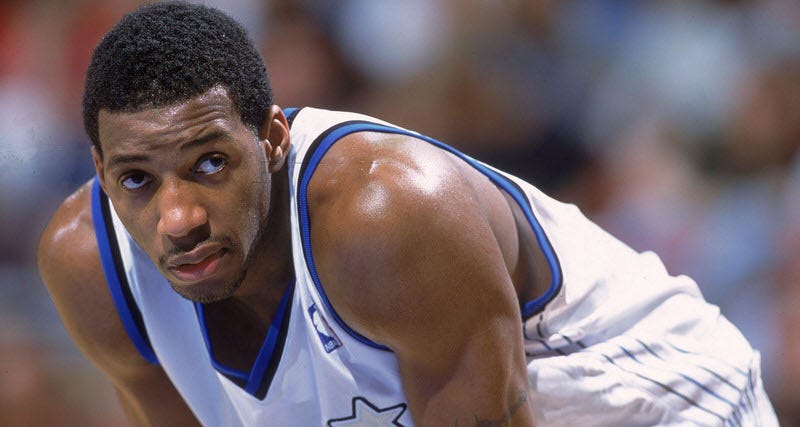
but statistics don't capture what watching tmac in 2002-03 actually felt like.
this was not efficient production on a good team. this was one man on a 42-40 roster: jacque vaughn, andrew declercq, drew gooden, gordan giricek. carrying the entire franchise on his back.
his offensive box plus minus that season was 9.8
the second best single season mark since 1973-74.
the only player ahead of him in that metric for that entire fifty year span is michael jordan. jordan, who played with scottie pippen.
jordan, who played for one of the most well-constructed franchises in nba history.
mcgrady put up a jordan level offensive impact number on a team whose second scorer was a rookie.
when he won the scoring title that year, someone asked him how it felt. he said: "it's really cool, a big accomplishment for myself. i can't complain at all with where i'm at today, but i'm not satisfied with just this."
not satisfied with just this.
thirty two points a game and he was telling you it wasn't enough.
and years later, when someone asked him which version of himself was the best, he said: "i don't think anybody on the planet was better than '03 t-mac. nobody on the planet in '03, i don't think, was better than t-mac and imma stick to that."
he was right.
in 2003, on that 42-40 roster, tracy mcgrady was the best basketball player alive. better than kobe. better than duncan. better than anyone.
and imma stick to that.
"it feels good to get in the second round."
april 2003. the magic are the eighth seed. they draw the detroit pistons. the one seed.
50 wins, chauncey billups, rip hamilton, ben wallace, one of the most physical teams in the eastern conference.
nobody gave orlando a chance.
tmac dropped 43 in game one. 46 in game two. the magic won both on detroit's court. they came home and won game four to go up 3-1. one win away from the second round. one win away from breaking the first round curse that had followed him from toronto. one win away from finally climbing out of the pool.
and then he said it.
he replied in an interview, "it feels good to get in the second round."
he said it after winning game four. the series was 3-1. still a best of 7.
rick carlisle, the pistons' coach, took the quote, pinned it to the locker room wall, and handed a rookie named tayshaun prince the assignment of guarding the best scorer in the league.
prince was awkward and had barely played all season.
he locked tmac down.
the magic lost game five by 31. lost game six by 15 on their own court. lost game seven by 15 in detroit.
in the span of three games, one of the greatest individual playoff performances in nba history was transformed into a punchline. the 3-1 lead became the story. the "second round" quote became the defining image of his career. nobody went back and looked at what he had done to get there. nobody counted the games where he put his team on his shoulders and willed them to victory against a superior opponent with nothing but his own talent. nobody talked about the fact that he was twenty three years old, playing forty minutes a night, doing it all alone.
they just laughed at the quote.
mcgrady has spent the rest of his life having that moment used against him. and what nobody mentions is that in the four games he won before the collapse, he averaged over 36 points against one of the best defences in the league. jacque vaughn was his starting point guard.
drew gooden, a rookie, was his best supporting player. and he took the one seed to the absolute limit.
is that not showing leadership? is that not showing everything you have?
he tried, man. he tried.
62 and a franchise that was dying.
the following season, 2003-04, was supposed to be the year it clicked. mcgrady was still only twenty four. hill had started to find some health. the magic were going to be a different team.
instead doc rivers was fired after a 1-10 start. management and mcgrady began to fracture. the franchise was collapsing around him. and he was still averaging 28 points a game on a team that finished with the worst record in the east.
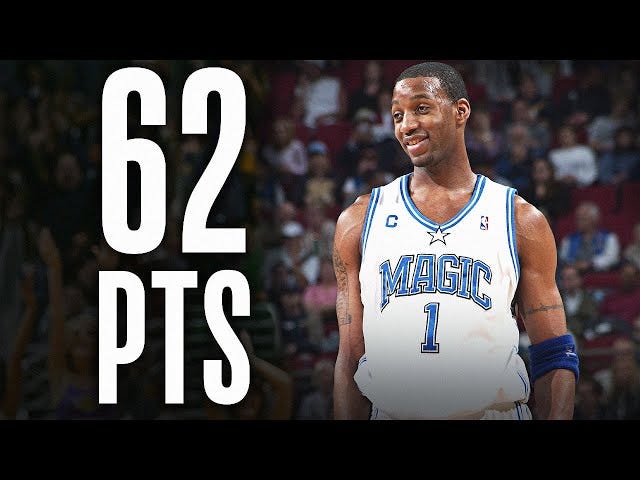
on march 10th, 2004, against the washington wizards, mcgrady scored 62 points.
sixty two.
in a winning effort.
on a team that had won 21 games all year.
the fourth highest single game scoring performance in nba history at the time.
i want you to picture that arena.
the empty seats.
the half hearted crowd.
the season going nowhere.
the franchise crumbling.
and somewhere in the middle of all that nothing, a twenty four year old put up the fourth highest single game scoring performance in nba history.
he was playing for nobody.
he was playing because the game was all he had and the game was the only place where everything made sense for him.
that's the cruelty of tracy mcgrady's career compressed into a single night. the best performance imaginable. on the worst possible stage. witnessed by nobody. remembered by almost nobody.
three months later, he was traded to houston.
the magic sent him to the rockets for steve francis, cuttino mobley, and kelvin cato.
it is widely considered one of the most lopsided trades in nba history. orlando gave away the best player in the eastern conference for a package of complementary pieces that never amounted to anything, and in return received the second overall pick in the following draft — which became dwight.
mcgrady left orlando carrying the weight of four years of impossible solo effort. 43, 44 minutes a night. carrying that roster through four seasons.
he later said: "in orlando during those four years, it really took a toll on me. i was averaging 40 something minutes a night. those four years tore me up."
nobody noticed the pool getting darker until it was too late.
houston. december 9th, 2004.
the rockets were losing to the san antonio spurs, 76-68, with 35 seconds left in the game.
people were leaving the building. the game was over. the spurs were the defending champions, led by tim duncan, tony parker, and manu ginobili: arguably the greatest trio in basketball at that moment. the night belonged to them.
and then tracy mcgrady locked in.
he got the ball at the top of the key with 35 seconds left.
he shot a three. it went in
spurs free throws. rockets down by five.
mcgrady rose again, drew the foul on tim duncan himself, and buried the shot through contact for a four-point play. when the ball went in, he said later: "all my superpowers just came back. i ain't missing."
when he hit the second three, the people who were leaving stopped walking.
when he hit the third three: a pull-up from 26 feet with 1.7 seconds left, over brent barry, one of the league's best perimeter defenders, to win the game 81-80, the toyota center lost its mind.
thirteen points in thirty five seconds.
four consecutive threes.
one of the most iconic individual moments in nba history.
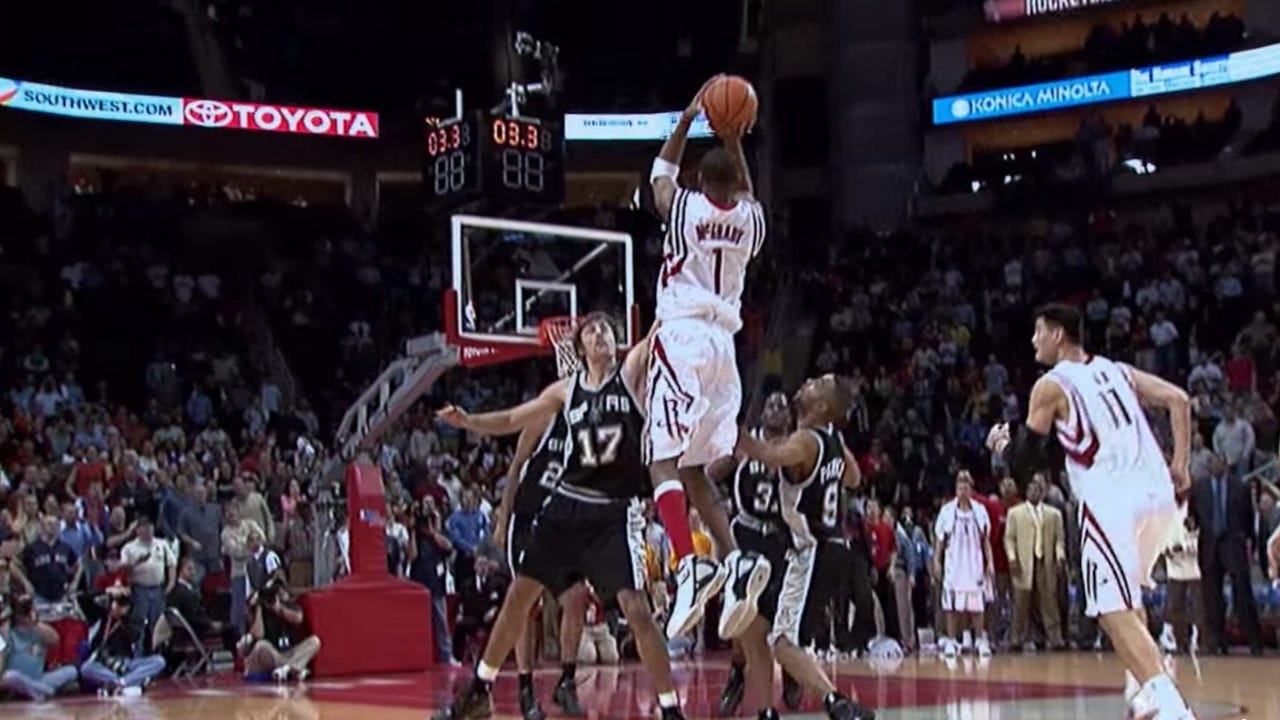
and the spurs, the team he had just dismantled in the final minute, went on to win the championship that year. meaning he beat the best team in basketball in their defining season in under a minute.
afterwards he described the experience as an out of body moment.
that is the thing about tracy mcgrady that the first round narrative always buries.
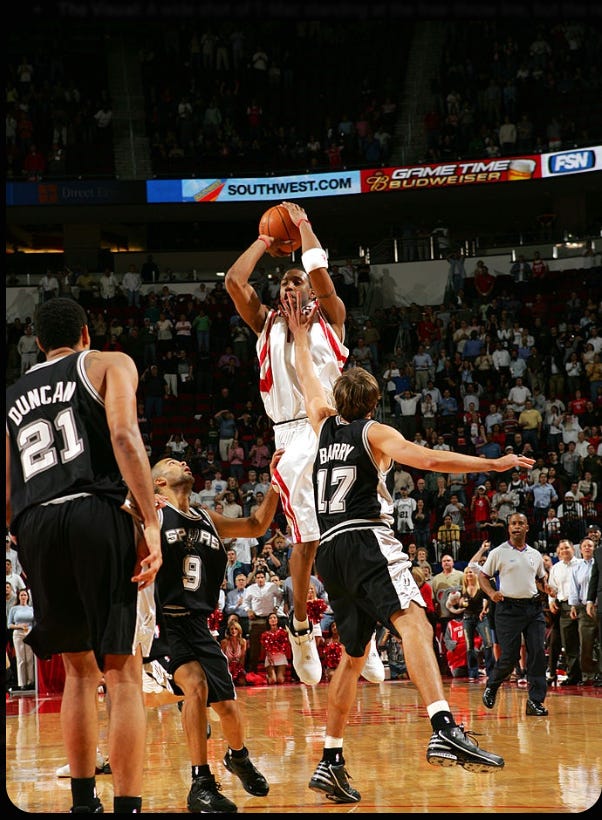
tracy mcgrady could do things that nobody else could do. he could manufacture moments from nothing.
tracy mcgrady could reach into a game that was already over and pull something out of it that defied every principle of probability.
the problem was that tracy mcgrady could never do it for long enough. and the body that god had given him, this impossibly fluid, impossibly gifted instrument, that had been spending in orlando finally paid the bill.
the pool has been drained.
the years after the spurs game are hard to read.
not because they were without brilliance. there were still nights: a 40-point game here, a stretch of dominant basketball there, when you could see the player he had been glowing through the broken body.
but the injuries came with an inevitability.
back spasms.
shoulder surgery.
knee surgery.
microfracture.
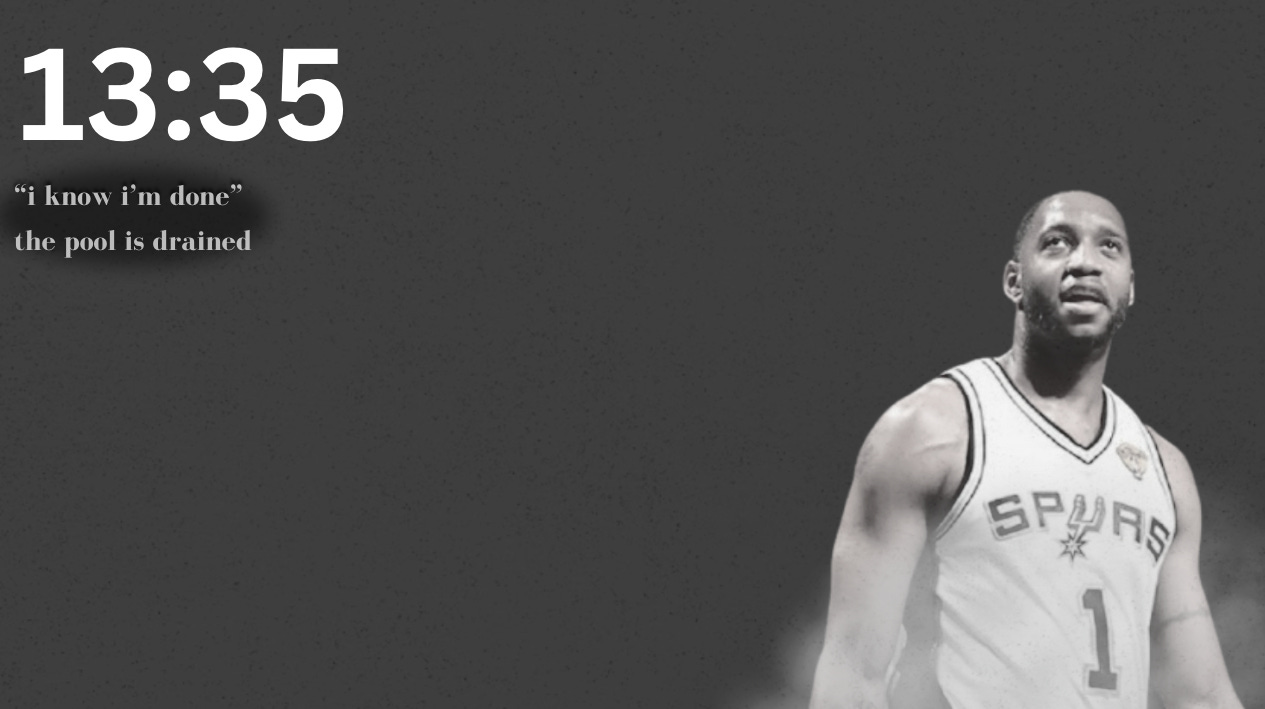
in 2009, lying in a chicago hospital room after microfracture surgery, he described a machine moving his leg for eight hours a day to help his blood circulate. "i know i'm done," he said, "and i'm not going to get that chance of competing for a championship."
the body that had carried him through orlando. that had scored 62 on a wednesday night in an empty arena. that had conjured 13 points in 35 seconds against the best team in basketball. that body had finally said no more.
after the 2007 loss to utah in game seven, still visibly emotional at the press conference, he had said: "i tried, man, i tried."
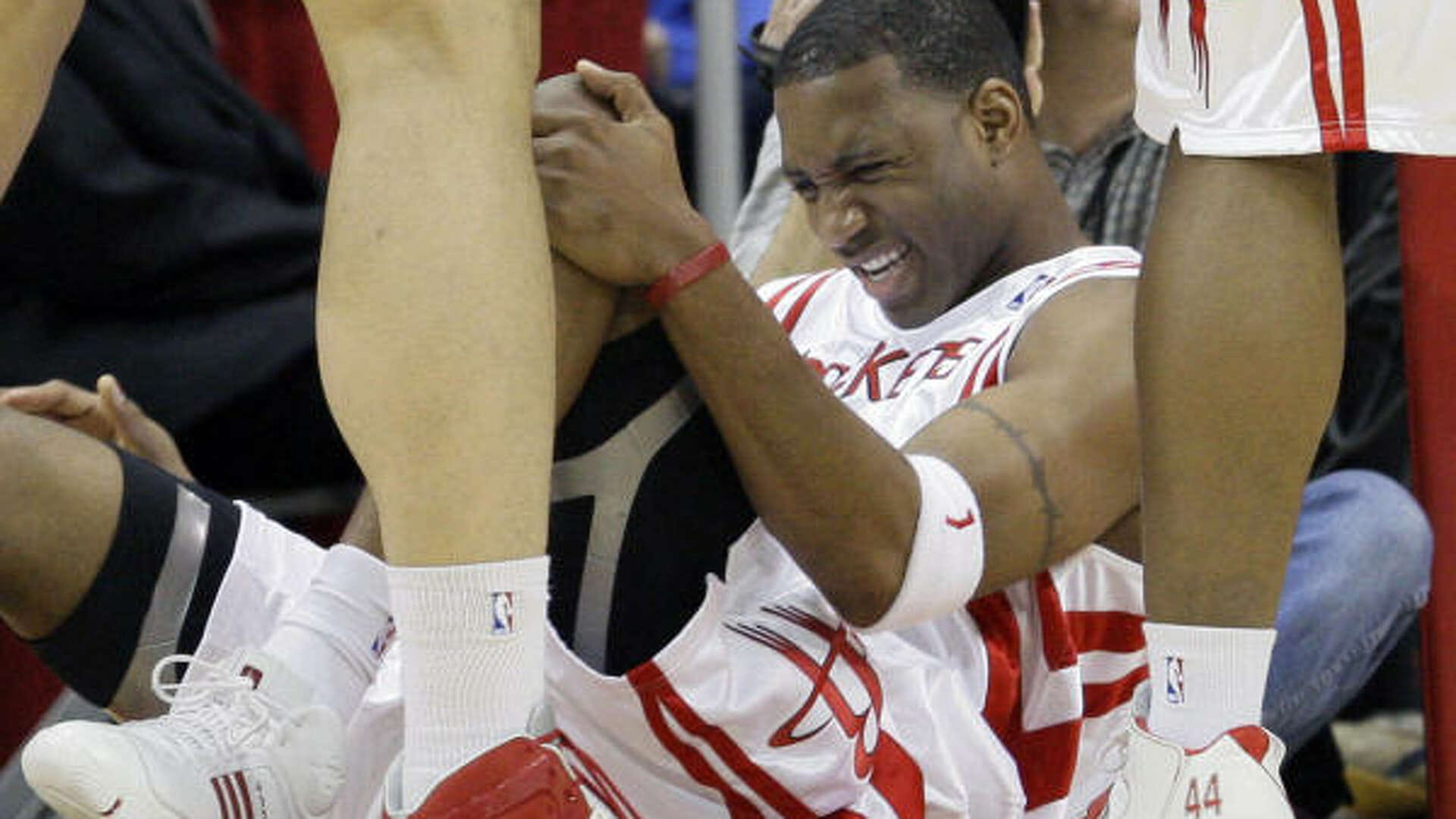
those four words might be the most honest thing any athlete has ever said.
i tried.
not i was cheated. not the team failed me. not the refs were wrong or the bounce didn't go my way. just four words that contained an entire career.
every minute in toronto.
every 40 minute night in orlando alone.
every first round exit.
every moment the water got a little darker.
i tried, man, i tried.
the pool was empty
the end. and the after.
tracy mcgrady made it to the second round of the playoffs exactly once in his career.
it was 2013. he was thirty three years old. he signed with the san antonio spurs in april as insurance, the management told him directly that he was unlikely to play. he sat on the bench through their run to the finals, watching in a suit while manu ginobili struggled in a series they ultimately lost to miami. he logged thirty one minutes across six games. his first career minutes outside the first round.
he retired three months later on espn's first take. his parting words: "it's been 16 years playing the game i love. i've had a great run, but it's time for it to come to an end."
no bitterness. no excuses. just a man stepping out of the pool after a very long swim.
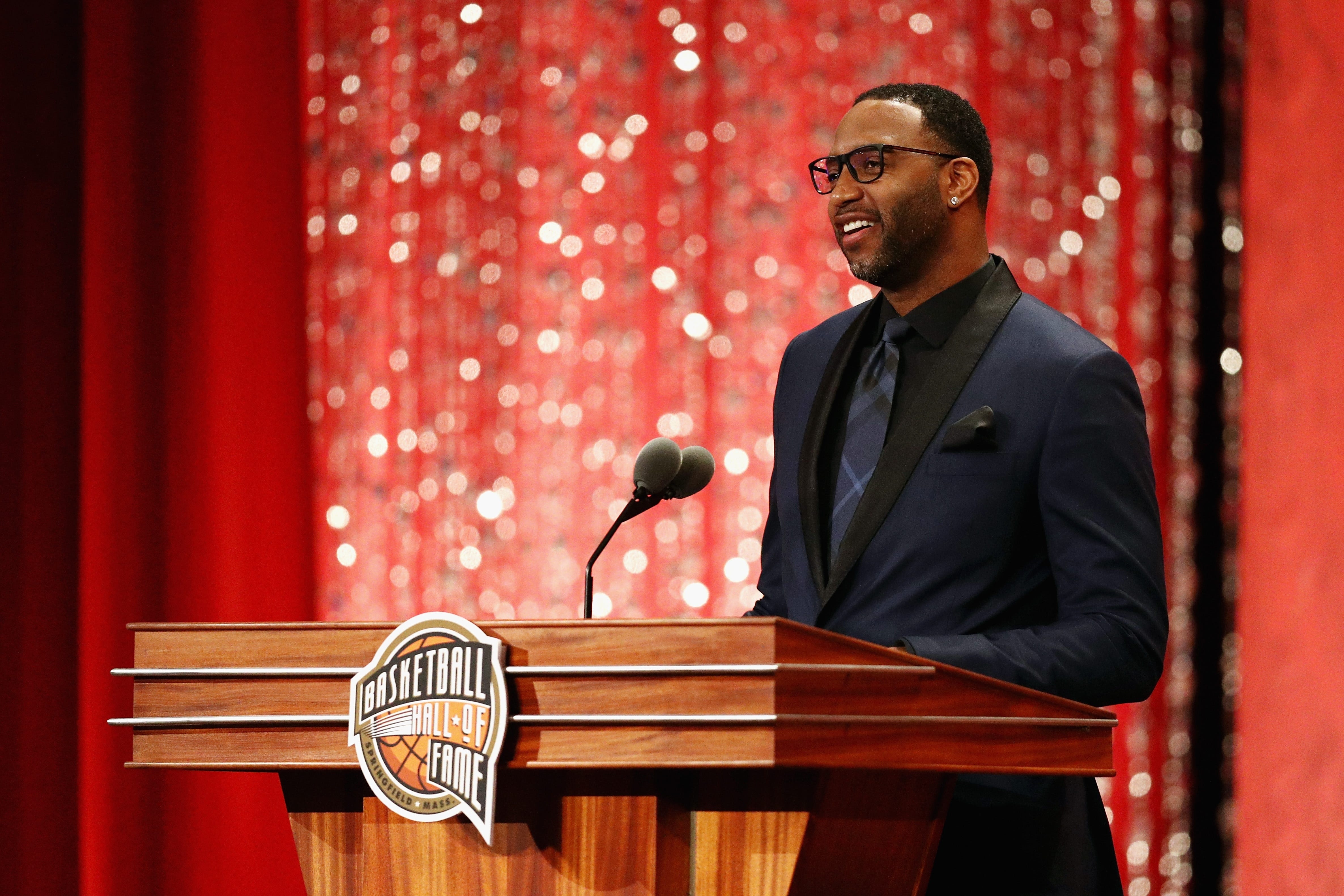
he was inducted into the naismith memorial basketball hall of fame in 2017.
the ceremony was long overdue and the basketball world gave him his flowers properly.
kobe sent a message. lebron tweeted congratulations. the people who had actually watched him, really watched him, not just checked his playoff record, understood exactly what they had seen.
but here is the thing about flowers that arrive late.
the garden is already gone.
the pool was empty by the time the world showed up to admire it. the prime that should have had championships and parades and the kind of legacy that gets carved into the permanent record of the sport.
that prime was spent alone in orlando carrying a broken roster through half-empty arenas, averaging 43 minutes a night until his body couldn't anymore.
they had seen a player who was, for four consecutive seasons, as good as anyone who has ever played the game. they had seen someone do things with a basketball that violated the laws of physics and common sense on a regular basis.
they had seen someone in the pool.
and the pool was the most beautiful place any of us had ever been.
we just didn’t say it out loud until after the water was gone.
and by then the only thing left to say was what he had already said himself, four words, at a press conference in houston, after another first round exit, with tears in his eyes that he wasn’t bothering to hide.
i tried, man.
i tried.
thanks for reading.
JESHAL. This was such an incredible READ! As always, the way you blend this narrative style with facts from the time and such beautiful lines… wow. Every time I read about McGrady his story just feels so heartbreaking to me. I have to watch some videos of him in his prime later, honestly.
🔥🔥 poetry! 03 T-Mac was special